
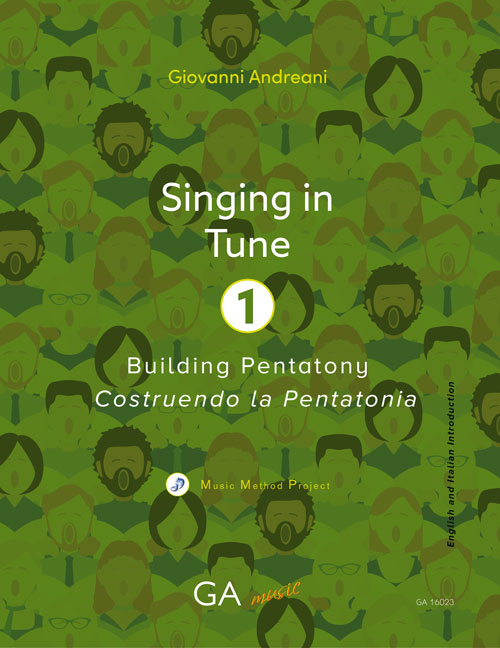
Singing in Tune 1 - Building Pentatony
This book contains 142 melodies organised and proposed according to criteria developed over many years of teaching. They have proven to be reliable music material for a training course where the main objective is singing in tune. Each chapter presents a new system of tonal functions and each is divided into two sections: melodies written combining sol-fa syllables with a rhythmic line without the use of the stave, and melodies on the stave. From now on, melodies written combining sol-fa syllables with a rhythmic line (also known as ‘rhythmic sol-fa’), will be defined as ‘open-field’ melodies.
The melodies in this book can be sung using the solmisation system known as tonic sol-fa: the sol-fa syllables represent the degrees of the diatonic scale for the tonal model where the doh syllable represents the tonic of the major scale regardless of the key in which it lays. The syllables do, re, mi, fa, sol, la, si (ti) are abbreviated in: d r m f s l t. At this level, they are gradually introduced, forming various pseudo-pentatonic sets which will represent the basis from which to discover – and be aware of – the tonal system.
Open-field melodies offer the opportunity to sing in tune more easily: each student will be able to focus his/her attention on the semantic property possessed by each sound in relation to its tonal function, without having to read notation from a stave. As soon as intonation is strengthened and the melodies are sung fluently, the student will simultaneously begin dealing with melodies on the stave. The stave is introduced gradually, first as a system with one line (monogram) on which sounds within the range of a third can be represented, then as a system of two and three lines (bigram and trigram). In the fifth chapter, melodies on a staff are represented in definite keys; nevertheless, they are notated without a key signature: accidentals, therefore, will appear at the moment, ‘in itinere’. This method is adopted to accustom students to using absolute sounds belonging to a specific key, making them clear every time they are needed. At the same time, by using the sol-fa system, the student will adopt a unique syllable combined to a specific tonal function, regardless of which key it is in.
The melodies in this book can be sung using the solmisation system known as tonic sol-fa: the sol-fa syllables represent the degrees of the diatonic scale for the tonal model where the doh syllable represents the tonic of the major scale regardless of the key in which it lays. The syllables do, re, mi, fa, sol, la, si (ti) are abbreviated in: d r m f s l t. At this level, they are gradually introduced, forming various pseudo-pentatonic sets which will represent the basis from which to discover – and be aware of – the tonal system.
Open-field melodies offer the opportunity to sing in tune more easily: each student will be able to focus his/her attention on the semantic property possessed by each sound in relation to its tonal function, without having to read notation from a stave. As soon as intonation is strengthened and the melodies are sung fluently, the student will simultaneously begin dealing with melodies on the stave. The stave is introduced gradually, first as a system with one line (monogram) on which sounds within the range of a third can be represented, then as a system of two and three lines (bigram and trigram). In the fifth chapter, melodies on a staff are represented in definite keys; nevertheless, they are notated without a key signature: accidentals, therefore, will appear at the moment, ‘in itinere’. This method is adopted to accustom students to using absolute sounds belonging to a specific key, making them clear every time they are needed. At the same time, by using the sol-fa system, the student will adopt a unique syllable combined to a specific tonal function, regardless of which key it is in.
|
Composer: Giovanni Andreani
Instrument(s): Voice Difficulty: Elementary (what does this mean?) Publisher: GA-music Genre: Education, Teaching Method, Exercises Book Type: Printed, Perfect Bound Size: 280 x 216 mm Number of pages: 92 Contents:
This book can be ordered through the leading Online Retailers or at you nearest Bookstore providing the following ISBN code: 9788894112221
You may refer to a specialised online marketplace for books such as AbeBooks (abebooks.com) or Book Depository (bookdepository.com), among others. Some retailers provide a regional version of their websites, with a specific domain suffix (.com - .fr - .co.uk - .de - .it - etc.)
|